

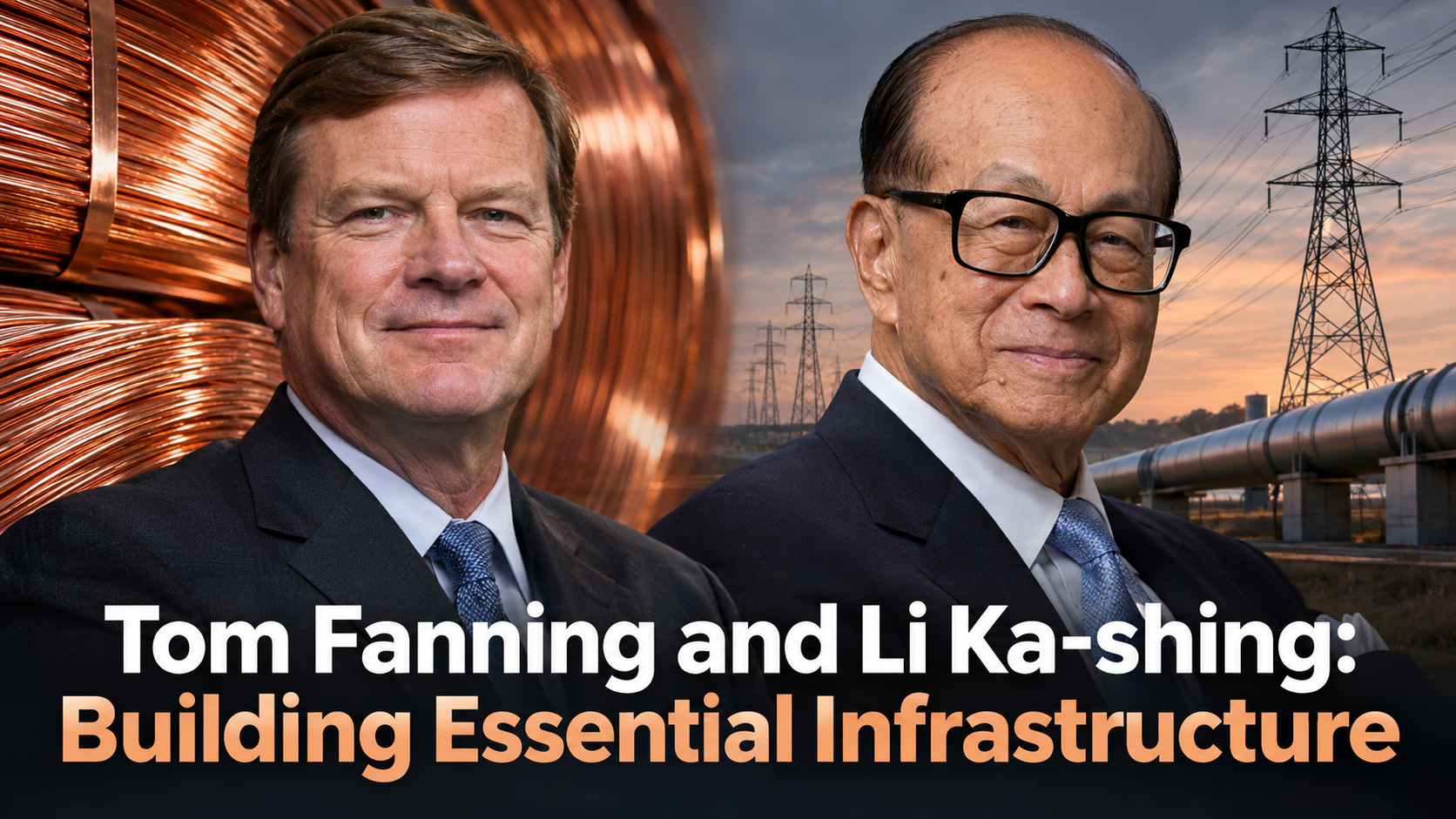
Tom Fanning and Li Ka-shing can be compared through the businesses behind essential services, but they should not be described as interchangeable executives. Fanning is a former Southern Company leader; Li is the business founder associated with the Cheung Kong group. Their histories raise practical questions about infrastructure, long-term investment and the difference between corporate scale and personal wealth.
There is no verified joint project established by the sources examined here. The comparison instead concerns how large organisations support services that customers depend on repeatedly. Electricity networks, property and other physical assets are not merely financial symbols. They require maintenance, investment and management long after an initial transaction or public announcement.
First, correct the timeline
Fanning should not be called Southern Company’s current chief executive in a new profile. The company’s December 2023 retirement announcement states that he stepped down as CEO in May 2023 and retired as executive chairman at the end of that year. The distinction prevents an old executive biography from becoming a false current claim.
Li’s own succession history also needs dates. CK Hutchison’s senior-adviser profile identifies his advisory position from May 2018. “Founder”, “former chairman” and “senior adviser” describe different relationships with an institution. A person’s historical influence does not mean that every later operating decision was personally theirs.
Tom Fanning and Li Ka-shing: what makes infrastructure different?
Infrastructure businesses often provide services people notice most when something goes wrong. A reliable electricity supply or a functioning physical asset can fade into the background of daily life. That makes continuity an important part of value. The business cannot judge its work solely by the attention attracted by a new launch.
This also changes the meaning of growth. Adding customers or assets can create opportunities, but it can add maintenance obligations and capital requirements as well. A larger system needs enough investment and operational capacity to remain dependable. Scale is therefore a starting point for analysis, not automatic proof that management has achieved a better outcome.
The distinction between announcement and delivery is especially important. A plan for a large project may involve financing, approvals, construction and commissioning before customers receive any service. Each stage has its own uncertainties. Reporting should describe which stage has actually been reached instead of treating a proposed investment as a fully functioning asset.
Fanning’s career belongs to the utility-management context
Southern Company’s succession records place Fanning within an established energy organisation. That context matters more than a generic description of him as a wealthy businessperson. Utility leadership involves an operating system, a workforce and commitments to customers. The chief executive’s role sits within those obligations rather than outside them.
Electricity is also a service with a distinctive relationship to time. Customers need it when they need it, not simply when production or supply is convenient. Planning must account for the continuing operation of the system. This helps explain why reliability, investment and execution belong alongside financial results in any serious discussion of utility management.
A leader’s record nevertheless needs careful attribution. Infrastructure can take years to develop, and a project may span several management teams. It would be misleading to assign an entire asset’s history to one executive without examining the relevant decisions and dates. The organisation’s outcomes and an individual’s responsibilities are connected, but they are not identical.
How to read an executive transition
A succession announcement usually identifies the role being transferred and its effective date. Sometimes a departing CEO remains chairman for a period; sometimes the person leaves the board as well. These arrangements create different responsibilities. A reliable profile should state the actual sequence rather than compressing every transition into a vague statement that someone “left the company”.
In Fanning’s case, Southern Company’s announcement provides that sequence directly. It is better evidence for the transition than an undated biography still displaying his former title. Historical biographies remain useful for career background, but current-role claims should be checked against the company’s later announcements and governance records.
Li’s background adds ownership and diversification
The Li Ka Shing Foundation’s history of its founder traces his beginnings in manufacturing and subsequent expansion into property and a larger business group. This introduces a different perspective from advancing through an established utility company. Founding and expanding enterprises involves ownership decisions as well as management appointments.
Diversification means that a group has exposure to more than one activity, but the label does not remove risk. Different businesses can have different customers, regulations and funding needs. Some risks may be spread across the group, while others can arise from complexity. A useful analysis asks what the activities actually are and how their financial and operating relationships work.
The founder’s name can become a shorthand for that complex structure. Readers should resist the temptation to treat the shorthand as a complete explanation. A group contains legal entities, managers and shareholders with defined roles. A current development in one part of it should be traced to the relevant company rather than attributed automatically to the founder.
Three questions that make the comparison useful
The first question is what service or asset creates the underlying value. A company can have a recognisable leader and still need a clear operating explanation. Identify what customers receive, how the business earns revenue and what it must spend to keep delivering. This turns a personality profile into an understandable account of economic activity.
The second question is how long the commitments last. Physical assets can require investment before income arrives and maintenance after the original construction is complete. A short reporting period may not capture the whole decision. Readers need to distinguish annual results from the longer life of the asset being discussed.
The third question is who bears which risk. Shareholders, lenders, customers, employees and public authorities can have different interests. Their exposure depends on contracts, regulation and the structure of the business. Calling a project “successful” without naming the perspective can conceal important differences between financial returns, service quality and the cost paid by users.
What not to infer from headline figures
A utility’s assets are not the chief executive’s personal assets. A conglomerate’s sales are not its founder’s disposable income. Compensation, share ownership and private wealth also require different sources. Combining them in a wealth table creates the appearance of comparison while obscuring what the figures actually measure.
Even a verified financial amount needs a date and definition. An investment commitment may be spread over years; a market valuation can change with prices; a reported compensation award may have conditions. This article therefore does not present a personal wealth ranking. Its focus is the more supportable comparison between professional roles and the kinds of businesses they helped shape.
Using online business coverage responsibly
Start with company announcements for appointments and completed corporate events, then use the relevant financial or operating records for broader performance claims. A source may be authoritative about its own transaction while still presenting its strategy in favourable terms. Clear attribution allows readers to understand both the fact being reported and the perspective of the institution reporting it.
For additional context on checking web-based information, see TechyHitTool’s Newsboostspot.com overview and its guide to review evidence and testing. These reading resources do not imply any involvement by Fanning, Li or their associated organisations.
Frequently asked questions
Is Tom Fanning still Southern Company’s CEO?
No. Southern Company’s retirement announcement records his move out of the CEO role in May 2023 and his retirement as executive chairman at the end of 2023.
What role does CK Hutchison identify for Li Ka-shing?
The company identifies him as a senior adviser from May 2018. That description should be kept separate from his historical chairman role.
Do Tom Fanning and Li Ka-shing have a verified joint business?
The sources reviewed here do not establish one. The article compares infrastructure-related business contexts rather than asserting a partnership.
Does diversification guarantee safety?
No. Different activities can spread some exposures while adding operational and organisational complexity. The underlying businesses and their obligations still need to be assessed.
Why are company assets not personal net worth?
Corporate assets belong within a legal and financial structure that includes liabilities and ownership interests. A person’s net worth requires a separate account of personal assets and debts.
