

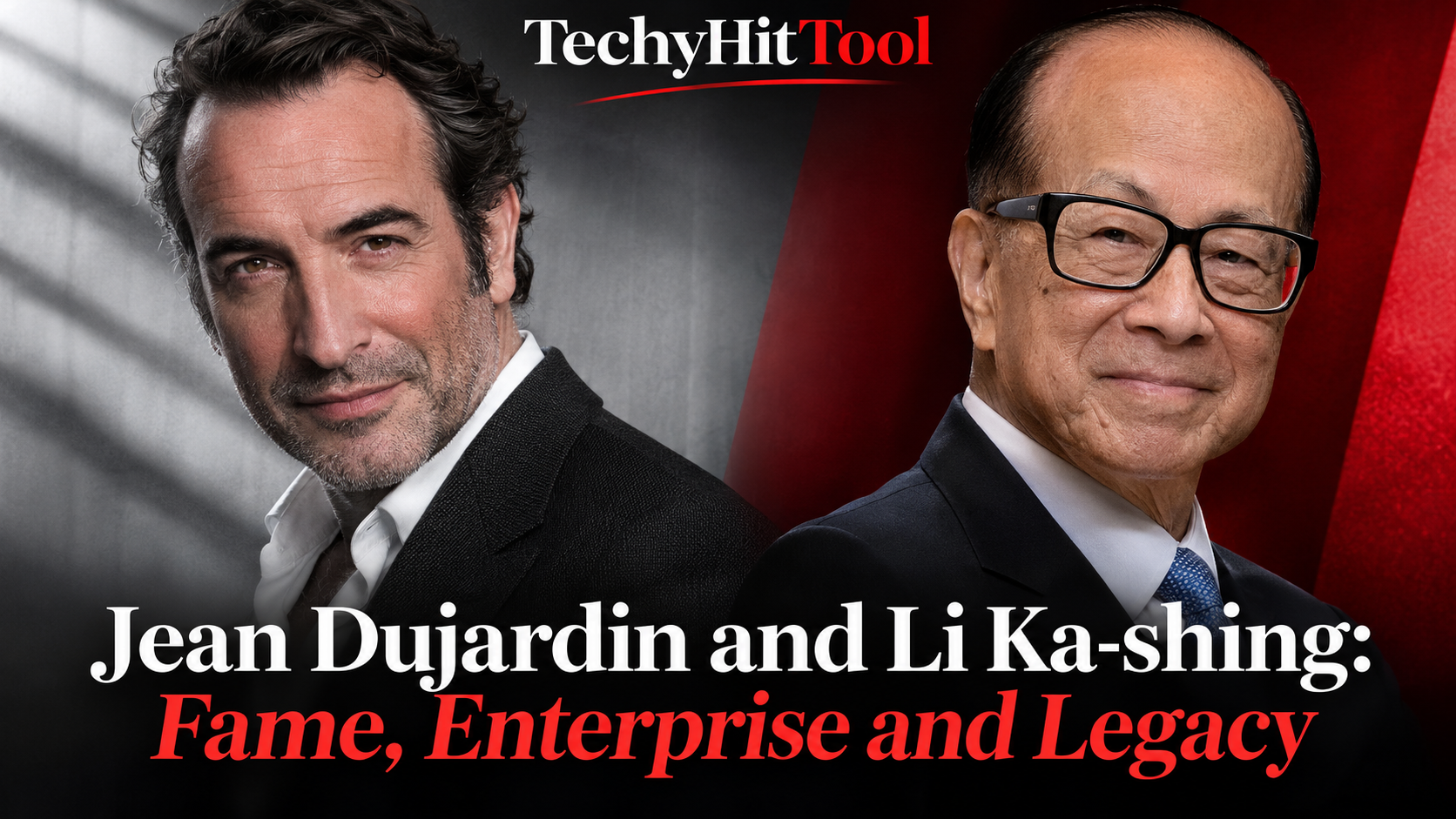
Jean Dujardin and Li Ka-shing are prominent figures in different fields: Dujardin is an actor recognised internationally for The Artist, while Li is a business founder and philanthropist associated with the Cheung Kong group. Their careers offer a comparison of cultural recognition and institutional influence. The sources reviewed here do not establish a collaboration or family relationship.
That boundary matters. A paired keyword can tempt a publisher to invent a reason the two names belong together, but a useful comparison does not need a fictional connection. It can explain what each person achieved, how the evidence differs and why fame, business ownership and personal wealth should not be treated as equivalent ideas.
Jean Dujardin and Li Ka-shing: what is actually documented?
Dujardin’s international film recognition can be checked through award records. Li’s enterprise history can be checked through company and foundation accounts. These sources establish separate public careers. They do not show that the actor and the business founder share a venture merely because both are well known.
The comparison becomes clearer when the question is specific. If the question concerns an acting award, the appropriate evidence is the award-giving institution’s record. If it concerns a founder’s corporate role, use a company biography or governance disclosure. A general celebrity page is not an equally strong source for every kind of claim.
The Artist and the meaning of Dujardin’s Oscar
The Academy’s 2012 ceremony record lists Dujardin as the leading-actor winner for The Artist. It is a specific achievement attached to a specific performance. The year identifies the awards ceremony, which is not necessarily the same as a film’s release year. Keeping those dates distinct avoids a common error in entertainment profiles.
An acting award is recognition within a creative field. It can increase attention to a performer and encourage new audiences to explore their work. It does not disclose every financial detail of the production or establish the actor’s personal net worth. Commercial contracts and award recognition are separate subjects, even when success in one may influence opportunities in the other.
The performance itself also belongs to a collaborative film. Direction, writing, editing, music, cinematography and other actors all contribute to the finished experience. A profile can celebrate an individual achievement while recognising that the work reached the audience through a larger production. Treating a film as the accomplishment of one person alone would misdescribe how cinema is made.
Why screen identity and personal identity differ
An actor can become strongly associated with a character, especially when a performance reaches a large international audience. That association is useful for discussing the work, but it should not become a claim about the performer’s private personality. A role is an interpretation within a fictional or dramatised setting, not a complete biography of the person playing it.
Readers can therefore ask two separate questions: what does the character do, and what is documented about the actor’s career? The first belongs to criticism; the second to reporting. Keeping them separate allows both to be more accurate and avoids turning imaginative interpretation into unsupported personal claims.
Li’s legacy is rooted in businesses and institutions
The Li Ka Shing Foundation’s founder account traces his business beginnings to the establishment of Cheung Kong Industries in 1950. It describes subsequent property activity and the expansion of a business group. This is a different form of public achievement from an acting award: it concerns organisations, assets and sustained economic activity.
An operating business has obligations that continue beyond a public milestone. It must provide goods or services, manage employees, maintain assets and meet financial commitments. A founder’s reputation can draw attention to those activities, but the organisation’s work depends on many people and systems. The founder and the business should not be treated as legally or financially identical.
The foundation account records Li’s retirement as chairman in 2018. His continuing association with the group’s history does not make an old executive title current. Readers should look for dated role descriptions when assessing later developments. This is especially important when profiles are copied from older articles without checking whether a management transition has occurred.
Two different kinds of international recognition
A film can cross borders through distribution, festivals, awards and audience interest. A business group can operate internationally through investment, subsidiaries and commercial relationships. Both can make a person’s name familiar in many countries, but the mechanism is different. Recognition should be explained through the activity that produced it rather than treated as a vague measure of global importance.
Language plays a different role in each setting too. A performance may communicate through expression, movement and a film’s visual form as well as dialogue. A multinational business needs arrangements for contracts, customers and operations across markets. These are not direct comparisons of skill; they show why international reach can mean very different things.
Nor does recognition automatically equal authority outside the person’s field. An accomplished actor is not automatically an expert on financial markets, and a successful founder is not automatically a film critic. Readers benefit when a profile identifies the area in which the subject’s achievements are documented and avoids extending that authority to unrelated claims.
What a responsible comparison leaves out
This article does not claim that Dujardin and Li have met, invested together or endorsed one another. Such statements would need their own reliable evidence. A comparison can be informative without adding an invented relationship. In fact, explaining the lack of an established connection helps readers understand the limits of what the paired keyword tells them.
It also avoids a numerical contest between an actor’s film receipts and a business group’s assets. Box-office revenue belongs to a film’s commercial performance, not automatically to its lead actor. Company assets belong within a corporate structure, not automatically to the founder personally. Each figure needs its own definition before it can support an argument.
Philanthropy is another institutional subject
Li’s foundation identifies education and medical work among its purposes. Those activities add a documented philanthropic dimension to his public career. They should be discussed through the foundation’s actual work rather than used as a general label suggesting that every activity associated with the founder is charitable.
More broadly, philanthropy can be reported through commitments, recipients and outcomes. An announced pledge is different from a completed transfer, and a foundation’s programme is different from a personal publicity appearance. These distinctions allow readers to evaluate what happened without relying entirely on the donor’s fame.
A better way to read mixed celebrity-and-business profiles
Start by identifying the people correctly, then define the comparison. Career history, public influence, ownership and creative achievement are all legitimate topics, but they should not be mixed indiscriminately. If an article introduces a dramatic shared story, ask which source actually establishes it. A pair of portraits is not evidence of a shared event.
For additional context about evaluating web information, TechyHitTool’s Newsboostspot.com overview and Certifiedquint.com guide offer related reading. They are not sources for an undocumented relationship involving either person in this article.
Frequently asked questions
Did Jean Dujardin and Li Ka-shing work together?
The sources reviewed here do not establish a shared project. Their careers are compared as separate examples of cultural and business achievement.
Which Oscar did Jean Dujardin win?
He won the leading-actor Oscar for The Artist at the 2012 Academy Awards, according to the Academy’s official record.
What is Li Ka-shing known for?
His public career includes founding Cheung Kong Industries, building a wider business group and philanthropic work through his foundation.
Are movie box-office receipts an actor’s earnings?
No. Box-office receipts measure ticket-sales revenue under a particular reporting definition. An actor’s compensation depends on separate contractual arrangements.
Why are their names compared here?
The comparison explains different forms of public recognition and institutional influence. It does not presume a personal connection or rank unlike careers on a single scoreboard.
