

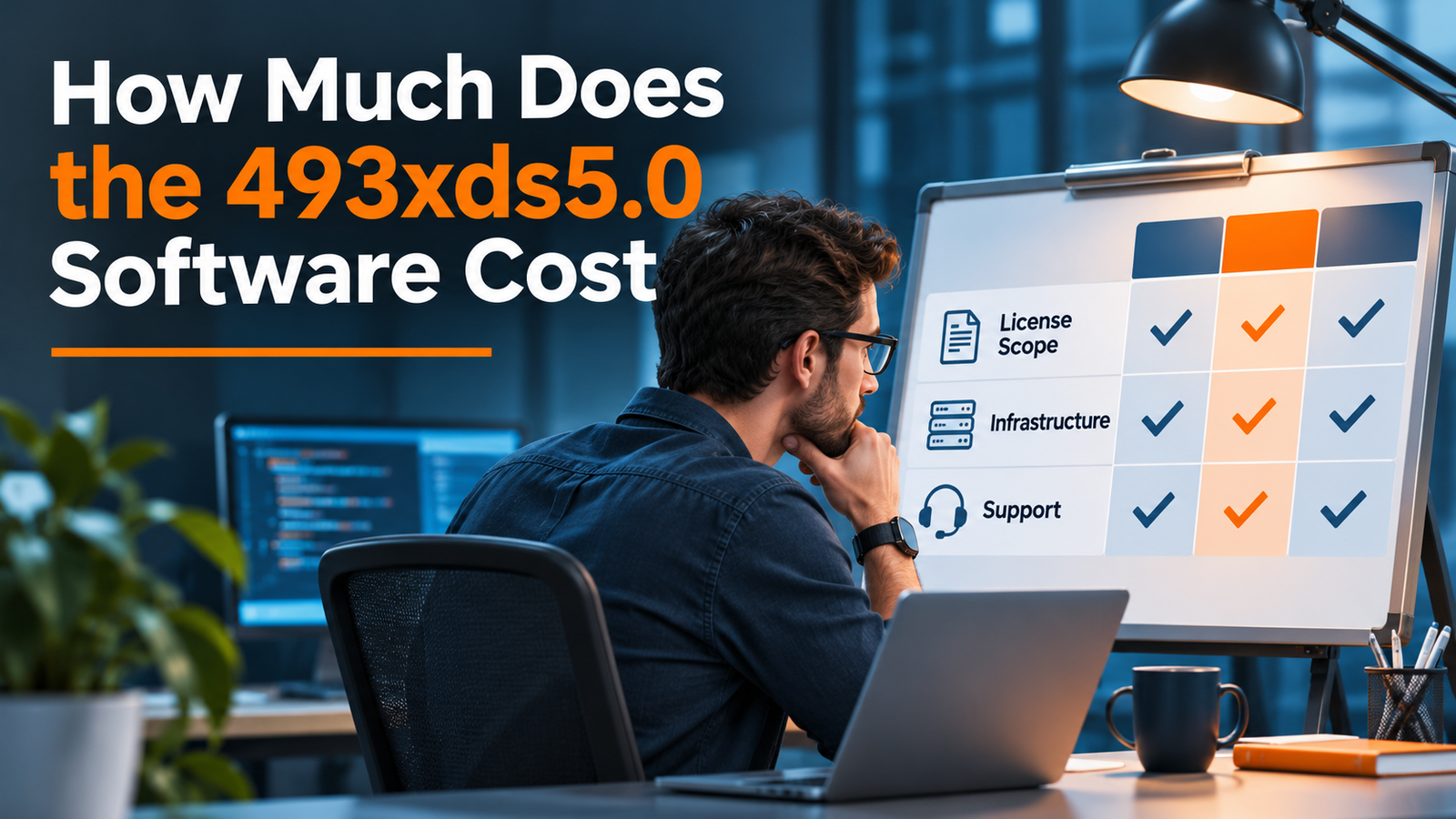
No authoritative price or verified technical product specification for the exact 493xds5.0 label was established in this research. Answering “How Much Does the 493xds5.0 Software Cost” therefore requires identifying the product and its seller before assessing the technical assumptions behind a quote.
For an engineering team, the important distinction is between a license amount and the cost of operating the promised system. Hosting, integration, maintenance and data transfer may belong to different parties. This guide explains how to review those boundaries in a hypothetical software proposal. It does not attribute unverified architecture, deployment options or pricing tiers to 493xds5.0.
Establish What the Technical Proposal Actually Sells
Ask whether the offer concerns a hosted service, a deployable application, a library or a custom development engagement. Those categories create different obligations. A hosted service may include infrastructure that a downloadable application requires the buyer to provide. A library may need substantial integration work before it serves an end user.
Request the exact product name, version, responsible organization and documentation. If the label is an internal part number, ask the seller to map it to the actual deliverable. Do not infer a language, operating system or database from a code-like name.
The product description and quote should refer to the same scope. If the technical demonstration uses one edition and the commercial offer covers another, ask which demonstrated functions are included. A price comparison is unreliable until those identities align.
How Much Does the 493xds5.0 Software Cost Per What?
The license metric determines how a quote scales. Ask whether the charging unit is a named user, concurrent user, device, project, environment or measured usage. These are possible contract models to investigate, not established features of this unidentified software.
Clarify how development, testing and production environments are counted. An application may need several environments for a responsible release process. If the quote covers only one, the team needs to know whether evaluation and staging require additional rights. Do not assume a production license includes every supporting use.
Ask who measures usage and how the buyer can inspect it. A commercial model based on requests or processed records needs a clear definition. Failed attempts, retries and background jobs can matter if the contract counts them, so the technical and commercial teams should review the same definitions.
Draw the Hosting Boundary
List the infrastructure the buyer must supply and the services the seller operates. Include compute, storage, backups and network dependencies only where relevant to the documented architecture. An unknown field should remain unknown instead of being filled with a generic cloud estimate.
For self-managed software, ask for a supported deployment specification and maintenance instructions. For a hosted service, ask what access and export mechanisms are available. Neither arrangement is automatically better; each should be evaluated against the team’s capacity and the application’s operational needs.
If the seller cannot explain where data lives or who maintains the service, the operating cost remains unresolved. A license quote cannot close that gap. Request clarification before presenting the proposal as a complete solution to stakeholders.
Separate Integration Work From Included Functionality
A demonstration can show data moving between two systems without proving that your integration is included. Identify the actual source, destination, authentication method and data mapping. Record which party builds and maintains the connection and what evidence will demonstrate completion.
Ask whether integration depends on a supported API or a fragile manual process. Read the relevant product documentation once the systems are identified. An unsupported assumption about access can turn an attractive quote into a project that cannot meet its intended scope.
Our development tool assessment guide explains how to distinguish a claim from a build contract. The technical provenance article describes why identifiers and package names should be verified before implementation begins.
Require Evidence for Security and Support Claims
Ask what the seller means by support: access to documentation, responses to tickets, defect fixes or operational assistance. Clarify service hours, escalation and which versions are covered. A general promise of “premium support” is not a measurable description of what happens when a production issue occurs.
Security claims also need specific evidence. Ask how updates are delivered, how issues are reported and how the buyer learns about relevant fixes. Do not infer a mature maintenance process from polished branding or an unreferenced claim that the software is enterprise ready.
The NIST Secure Software Development Framework overview provides a useful vocabulary for discussing secure development practices. It does not certify this software, and referencing the framework is not evidence that a seller follows it. The proposal still needs its own supporting documentation.
Test the Cost Assumptions With a Representative Workload
Define a workload that resembles the intended use. Record the input volume, user actions and required outputs, then ask the seller to demonstrate it under agreed conditions. A small sample can reveal integration gaps, but it should not be presented as proof of performance at an untested scale.
Measure the resources and work the buyer must provide during the evaluation. If an engineer manually repairs every import, include that finding in the decision. A smooth final screen can conceal substantial preparation effort that the operational budget needs to recognize.
Avoid extrapolating a universal price from a private demonstration. The resulting estimate applies to the stated scope and assumptions. If those assumptions change, the cost review should be updated rather than defended as an established market rate.
Include Exit Work in the Technical Assessment
Request a sample export and inspect its structure. Confirm whether essential records, relationships and attachments can be recovered in a usable form. An export that cannot be interpreted outside the original application may leave substantial migration work for the buyer.
For projects distributed as Python packages, the Python Packaging User Guide explains the metadata and files associated with a documented package. That is an example of inspectable technical evidence, not proof that 493xds5.0 is a Python package.
Ask how the application is decommissioned and how access is removed. If the seller manages the service, clarify what happens to records after cancellation. If the buyer hosts it, identify which components remain the buyer’s responsibility after the license ends. These boundaries influence ownership cost even when no headline price changes.
Keep the technical review beside the commercial offer. Mark each assumption as confirmed, demonstrated or unresolved, and name the person responsible for closing the gap. This gives purchasing staff a clear explanation of why an apparently simple software charge may still need engineering review before approval.
Include a small ownership table in the internal assessment, with one named party for each essential service. If both buyer and seller believe the other maintains a component, the proposal has an operational gap. Resolve that gap in writing before treating the recurring price as a complete operating budget.
Frequently Asked Questions
Can Hosting Be Assumed to Be Included?
No. The deployment model and offer must establish that. A software label alone does not tell you which infrastructure, maintenance or backup responsibilities the seller accepts.
Is Per-User Pricing Always Easier to Budget?
It depends on the definition of a user and the team’s access pattern. Ask how temporary, read-only and administrative accounts are counted before comparing offers.
Does an API Mean Integration Is Included?
No. An API provides an interface; implementation, mapping, testing and maintenance may still require separate work. The quote should state which integration deliverables are included.
Does a Security Framework Reference Prove Compliance?
No. A framework can organize questions, but a seller needs evidence of its own practices. Do not treat a reference to NIST as certification of an unidentified product.
What Can We Say About the Price Today?
Only that an authoritative price for the exact label was not established here. A valid assessment requires a verified seller, a scoped offer and clear technical operating assumptions.
