

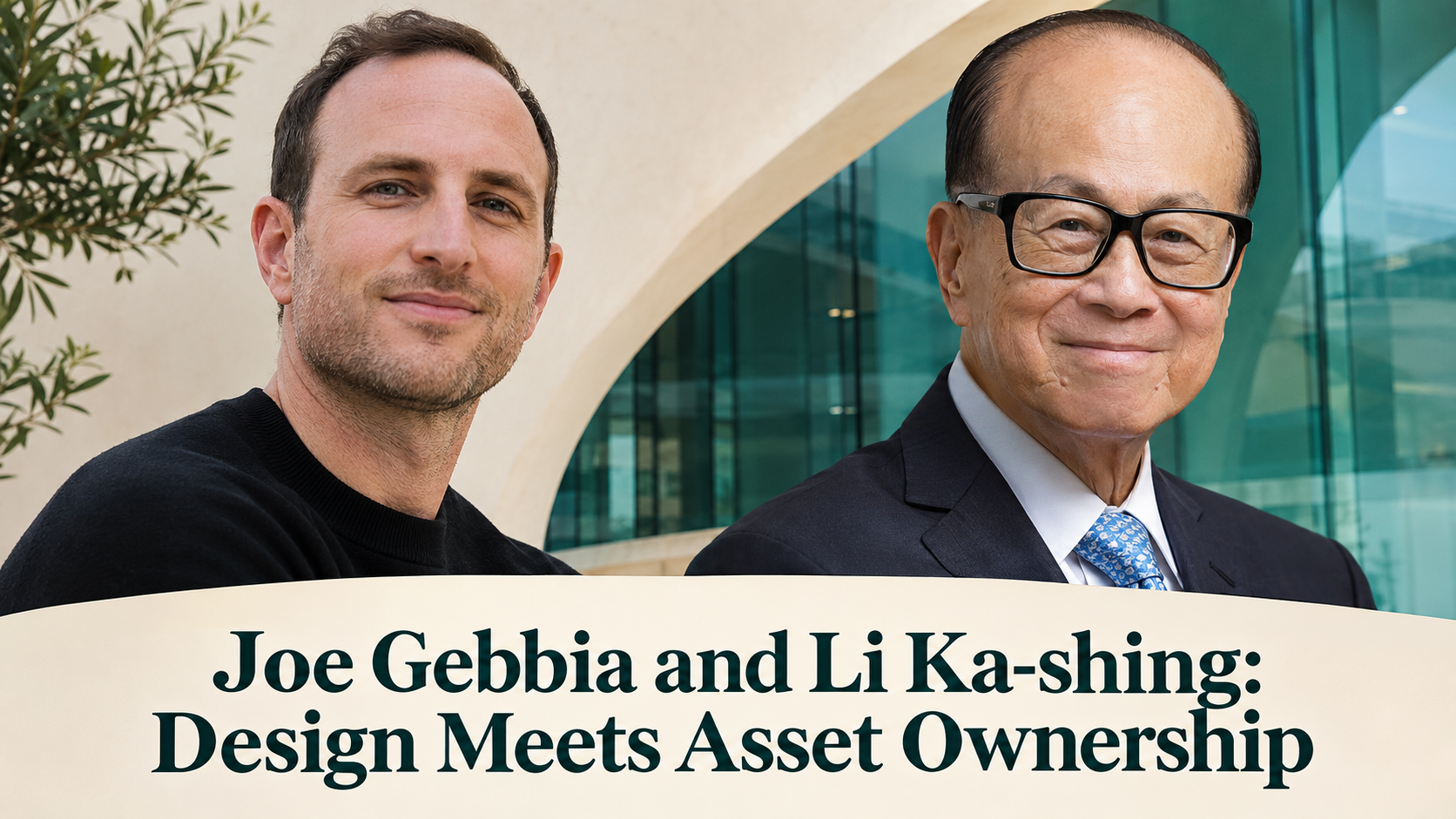
Joe Gebbia and Li Ka-shing offer a useful comparison between designing a service around how people use space and building businesses around the ownership and operation of assets. Gebbia is an Airbnb co-founder with a design background; Li founded Cheung Kong Industries and developed a wider business group. Their names together do not establish a business partnership.
Their careers intersect as a subject of analysis around housing, entrepreneurship and long-term institutions. That is different from claiming they have worked together. The most useful approach is to examine what each built, how the organisations operate and why a platform’s relationship to a property differs from owning the underlying building.
Begin with Gebbia’s design background
Airbnb’s Joe Gebbia biography identifies him as a co-founder and records his graphic-design and industrial-design education at the Rhode Island School of Design. This background helps explain why design is a relevant lens for understanding his public career. It is a documented part of his education, not a claim that every later business decision can be explained by a single qualification.
Design, in a business context, involves more than visual presentation. It can concern how people understand a service, what information they need and which steps make an experience confusing. A booking interface, for example, must help users make decisions about a real-world stay. Attractive graphics alone cannot resolve uncertainty about what the customer will receive.
The platform perspective also draws attention to the interaction between different participants. A service may need to work for both the person offering accommodation and the person looking for it. Their priorities are connected but not identical. A system that is easy for one side and frustrating for the other can struggle to maintain trust over time.
From digital services to manufactured homes
Tesla’s board biography of Gebbia records his launch of Samara in 2022 and describes its work on factory-made homes. It also identifies his Tesla board membership from 2022. These are separate activities, and readers should avoid merging them into a single company or assuming that one organisation owns another.
The move toward physical housing adds a different set of constraints from an online interface. A building has to fit a site and meet applicable requirements. Manufacturing and installation involve materials, logistics and local conditions. The general lesson is that a promising design idea must be translated into an operating process suited to the physical environment.
Li’s history begins with making and owning
The Li Ka Shing Foundation’s founder history dates Cheung Kong Industries to 1950 and describes Li’s later move into property development. This supplies a different route into entrepreneurship: beginning with manufacturing and expanding into assets and a larger business group. It should not be reduced to the idea that he simply bought shares in other companies.
Property ownership has its own relationship to value. The owner has an interest in the physical asset, but also faces costs, obligations and exposure to the place where it is located. A building cannot be moved between markets as easily as information can move between screens. Its usefulness depends on local demand, maintenance, access and many other practical conditions.
Li’s founder history also records his retirement as chairman in 2018. This date matters when describing his present relationship with businesses associated with him. A founder’s influence can remain important after a management transition, but that is not evidence that the founder personally makes every current operating decision.
Joe Gebbia and Li Ka-shing: platform access versus asset ownership
A platform can help people discover and transact over accommodation without owning every property available through the service. An asset owner has a different economic position in the building itself. Confusing these models makes it difficult to understand where revenue comes from, what costs exist and who is responsible for which part of the customer experience.
This is why scale should be described carefully. The number of listings on a platform is not the same as the number of buildings owned by a property company. A service’s transaction activity is not automatically its revenue. Likewise, the market value of a property portfolio is not the owner’s available cash. Each measure answers a different question.
The distinction also affects risk. A platform can face problems involving service quality, information and participant trust. A property owner faces the condition and financing of the asset as well as its use. The categories can overlap, but the underlying responsibilities need to be identified before comparing the businesses.
What both models must solve for the customer
People using a space need it to match the description they relied on. They also need to understand the price, the conditions of use and what happens if something goes wrong. Those needs exist whether the transaction begins through a digital service or a traditional property business. Design and operations meet at the point where a promise becomes an actual experience.
Trust therefore depends on more than a polished brand. Clear information, consistent processes and an effective response to problems matter. A well-designed interface can reduce confusion, but it cannot replace the quality of the underlying accommodation. Equally, a valuable building can still offer a poor customer experience if the service around it is difficult to use.
A responsible business profile should examine this relationship rather than treating design and assets as opposing ideas. Physical places need useful systems, and digital systems need something dependable behind the screen. The comparison between Gebbia and Li is interesting precisely because it puts those different starting points beside one another without pretending they are the same business.
Philanthropy and boards are separate parts of a career
Official biographies can include board memberships, charitable commitments and professional roles. Each should be described according to the source. A board role does not mean the person founded the company; signing a philanthropic pledge does not by itself establish how much has already been donated. Accurate distinctions prevent a profile from accumulating impressive but misleading claims.
Li’s foundation and Gebbia’s published biographies provide evidence of activities beyond their best-known businesses. Those activities add context, but they should not be used as shortcuts for evaluating a product or investment. A charitable commitment and a commercial offering have different purposes and need to be assessed on their own terms.
Why a precise wealth comparison would be incomplete
Company ownership can contribute to personal wealth, but the relationship is not as simple as assigning a company’s whole value to its founder. Other shareholders, liabilities and different classes of interests may matter. Private holdings can also be difficult to value consistently. Any credible estimate needs a clear date and an explanation of its assumptions.
This article therefore compares documented education, founding histories and business models rather than presenting an unsupported ranking. Readers seeking financial detail should distinguish a person’s holdings from company assets and transaction volumes. The category of the number matters as much as the number itself.
For related help evaluating online claims, TechyHitTool’s Certifiedquint.com overview and Newsboostspot.com guide discuss other information sources. They do not establish any affiliation with Gebbia, Li, Airbnb or their associated businesses.
Frequently asked questions
Are Joe Gebbia and Li Ka-shing partners?
The sources reviewed do not establish a joint business partnership. The article compares their separate careers and business models.
What did Joe Gebbia study?
Airbnb’s biography records degrees in graphic design and industrial design from the Rhode Island School of Design.
What is Samara?
Tesla’s Gebbia biography describes Samara as a business producing factory-made homes and dates its launch to 2022. It is a separate activity from Airbnb.
When did Li Ka-shing establish Cheung Kong Industries?
His foundation’s founder history gives 1950 as the starting date and describes his subsequent expansion into property.
Is a platform listing the same as an owned property?
No. Making a property available through a service does not establish that the platform owns it. Ownership and the right to facilitate a transaction are separate relationships.
