

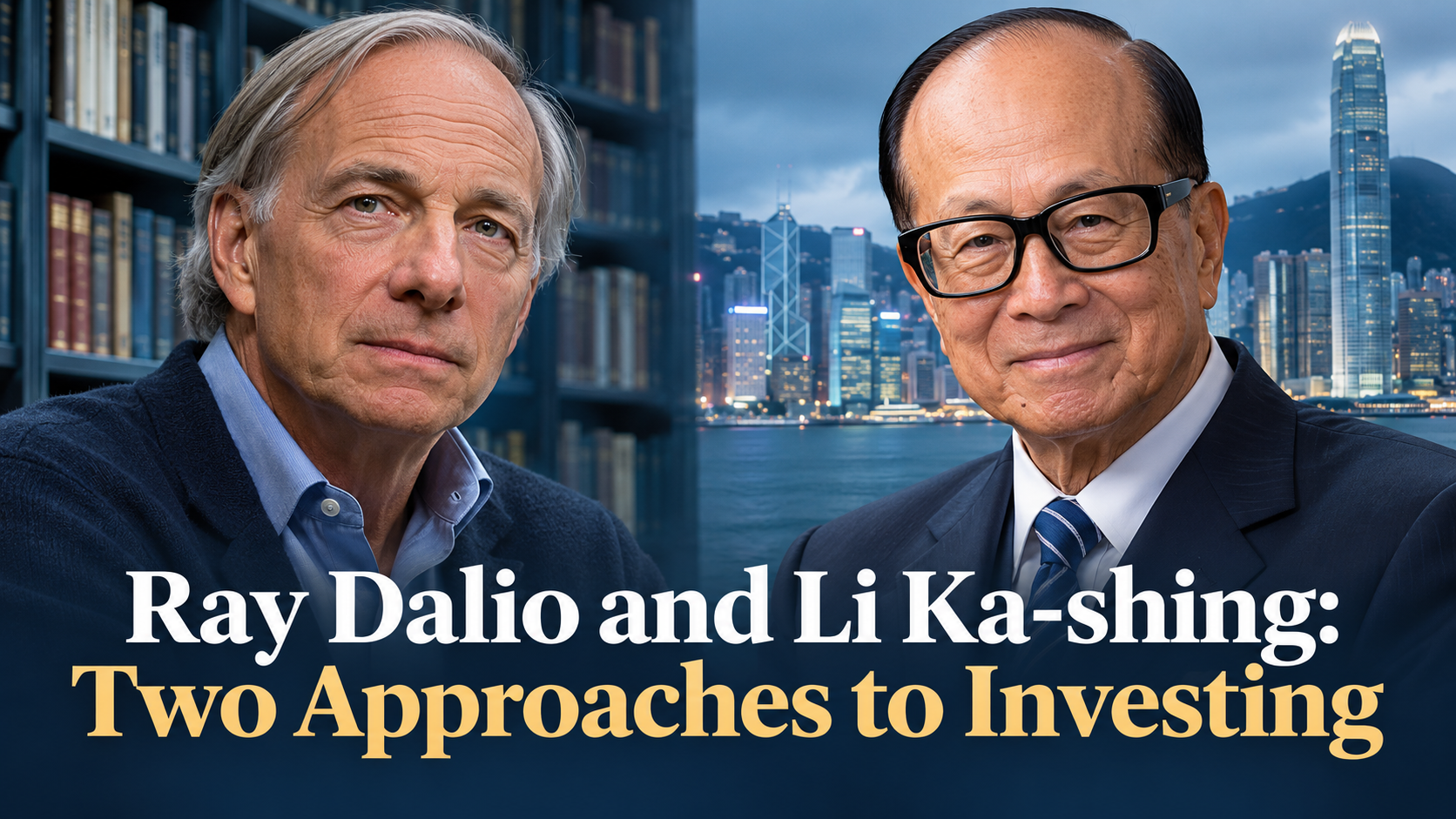
Ray Dalio and Li Ka-shing are known for building substantial financial institutions and businesses, but they reached that position through different kinds of work. Dalio founded the investment firm Bridgewater Associates; Li built businesses associated with the Cheung Kong group. Their careers are best compared through investment structure, ownership and succession, rather than a simplistic contest over personal wealth.
The sources reviewed here do not establish that they operate a joint investment business. Nor does placing their names together create a shared investment recommendation. A more useful question is what their documented histories reveal about the difference between managing portfolios and building an operating-business group, and how readers should interpret the financial figures attached to each.
Ray Dalio and Li Ka-shing: two starting points
Dalio’s career is associated with investment management, research and the organisation he founded. Li’s career includes manufacturing, property and the development of a diversified business group. Both involve capital allocation, but the assets, operating commitments and relationships with other investors can be very different. The word “investor” is too broad to explain those differences on its own.
A portfolio manager may oversee investments on behalf of clients under an agreed mandate. A business founder may hold ownership interests in enterprises that employ people and sell goods or services. These roles can overlap, but their reported financial scale needs to be understood separately. Assets managed, company sales and personal net worth measure different things.
Dalio’s Bridgewater history and the importance of succession
Bridgewater’s founder history records that Dalio established the firm in 1975. It also describes his departure from the CEO role in 2017, the chief investment officer role in 2020 and the chairman role at the end of 2021. Those dates matter because a founder’s historical influence should not be confused with occupying every former executive position today.
Succession is a significant part of institutional development. A firm that depends entirely on one person may struggle to preserve its methods when that person steps back. Building an organisation involves recruiting people, establishing processes and deciding how responsibility will pass to others. The founder’s role in creating that system is distinct from personally making every later decision.
For readers, this suggests a practical habit: check whether a biography is historical or current. An old conference profile can accurately describe the role someone held when the event took place while becoming misleading if copied into a new article without a date. The appropriate description should reflect the relevant period and avoid implying authority that the person no longer holds.
What a public investment philosophy can provide
A published framework can help readers understand the questions an investor considers important. It may explain how they think about uncertainty, organisational culture or economic conditions. It should not be treated as a personalised instruction to copy a particular trade. An institution’s resources, time horizon and obligations may be very different from those of an individual reader.
The distinction becomes especially important when short quotations circulate online. A general observation about economic cycles can lose its qualifications when reduced to a headline. Before applying it to a decision, readers need the full argument, its date and its assumptions. A well-known author’s name does not remove the need to examine whether the reasoning fits the situation.
Li’s operating-business background
The Li Ka Shing Foundation’s founder account traces Li’s business beginnings to Cheung Kong Industries in 1950 and describes his later move into property. It also records his retirement as chairman in 2018 to focus on foundation work. This is a history of enterprise development, not simply a list of financial-market positions.
Operating businesses add practical dimensions to capital allocation. A property or infrastructure asset has customers, maintenance requirements, local regulation and a physical location. Its value is connected to how those responsibilities are managed over time. An investor can assess the asset financially, but someone must still operate and maintain the underlying service.
Li’s long career also demonstrates why the identity of a group and the identity of an individual should remain separate. A founder’s reputation may continue to shape public perceptions after leadership changes. The businesses nevertheless have their own boards, managers and shareholders. Current claims about their activities should be checked against current company records rather than inferred from the founder’s historical prominence.
The practical difference between portfolios and enterprises
A portfolio can combine exposures to many assets. Its manager considers how those exposures interact, what risks they create and whether they fit the mandate. An enterprise must also make operating decisions: what to produce, where to invest, whom to employ and how to serve customers. The financial perspective and the operating perspective answer related but different questions.
Liquidity is one useful distinction. Some investments can be bought or sold in an active market, although market conditions still affect price and execution. A major physical business cannot necessarily be reshaped or sold quickly without costs and consequences. The time required to change direction influences how risk is assessed and how much flexibility a decision-maker actually has.
Control is another distinction. Owning a small interest in a company does not mean controlling its daily decisions. Holding a larger stake or occupying a management role may create a different relationship, but the exact rights depend on the structure. Readers should therefore avoid treating every investment as an acquisition of operational control.
Philanthropy belongs in the comparison, with clear limits
Li’s foundation identifies education and medical philanthropy as central areas of its work. This adds a documented institutional dimension to his public career. It does not mean that every business associated with him serves a charitable purpose, or that a foundation’s assets can be counted casually as the founder’s spendable personal wealth.
The same principle applies when discussing any wealthy person’s giving. A pledge, a completed donation and the continuing activities of a foundation are different facts. Each needs its own source and date. Philanthropy can be assessed through its stated purpose and recipient records without turning the entire subject into a ranking of public generosity.
Why this is not a net-worth leaderboard
Private wealth estimates involve assumptions about ownership, asset values and liabilities. Public share prices can change, and private assets may be difficult to value. A figure attached to a business group is not automatically the founder’s personal fortune. A figure attached to a fund may include client money that belongs to other people.
A credible comparison would specify the same valuation date, explain the methodology and acknowledge incomplete information. This article instead uses records that establish professional history and institutional roles. That approach is less dramatic, but it avoids presenting unlike figures as if they were directly comparable or independently audited personal accounts.
Reading investment coverage with better questions
Ask what the number measures, who owns the asset and when the information was recorded. Then distinguish the investment thesis from the outcome. An explanation can be coherent and still turn out to be wrong; a profitable outcome does not necessarily prove that every assumption behind it was sound. Careful analysis separates process, evidence and result.
TechyHitTool’s guides to testing commercial review claims and understanding Certifiedquint.com provide related context on evaluating online sources. They are not investment endorsements or evidence of a relationship with either individual discussed here.
Frequently asked questions
Did Ray Dalio and Li Ka-shing found a company together?
The sources reviewed for this article do not establish a jointly founded business. Their documented careers are examined separately.
When did Ray Dalio establish Bridgewater?
Bridgewater’s own history dates its founding to 1975. Its founder page also distinguishes Dalio’s former executive roles from later stages of his career.
When did Li Ka-shing retire as chairman?
His foundation records his retirement as chairman in 2018. Historical descriptions should not be copied as if they establish his current executive role.
Are assets under management the same as personal wealth?
No. They can include assets owned by clients or other investors. Personal net worth requires a separate assessment of an individual’s assets and liabilities.
Can readers copy either person’s approach directly?
Their histories can inform analysis, but they do not establish what is suitable for an individual investor. Resources, obligations, investment horizons and tolerance for losses differ.

1 Comment
Pingback: Martha Stewart and Andy Cecere Net Worth Comparison